Guns, Germs, and Steel Summary: Why Geography Shaped History

Introduction: Beyond Biological Explanations
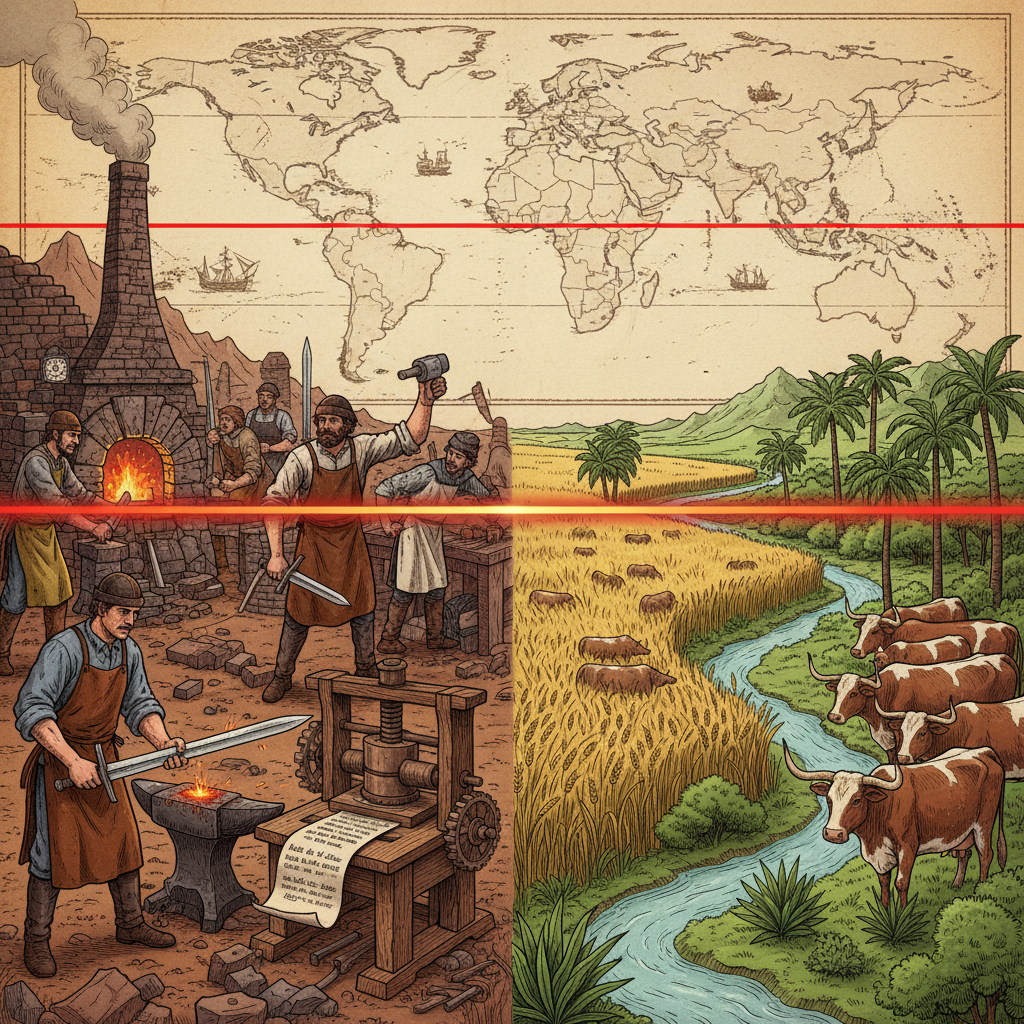
For centuries, the fundamental question of human history has been: why did some societies develop guns, germs, and steel while others remained hunter-gatherers or agrarian societies? In his Pulitzer Prize-winning masterpiece, Guns, Germs, and Steel: The Fates of Human Societies, Jared Diamond dismantles the myth of racial or genetic superiority. He argues instead that the divergent paths of human civilizations were shaped not by biological differences, but by environmental and geographical factors.
The core of Diamond\’s thesis is “geographic determinism.” This theory suggests that the physical environment—including the availability of domesticable plants and animals, the orientation of continental axes, and the presence of natural barriers—dictated which cultures would advance technologically and militarily. To keep up with deep dives into historical and sociological theories like this, you should Follow Unread Page for curated insights.
The Continental Axis: Influence of Latitude on Agriculture
One of Diamond\’s most compelling arguments involves the orientation of the continents. Eurasia stretches primarily East to West, sharing similar latitudes. In contrast, Africa and the Americas stretch North to South.
East-West vs. North-South
- Climate Consistency: Regions at the same latitude share similar day lengths, seasonal changes, and climates. This allowed crops and livestock domesticated in the Fertile Crescent to spread easily to Europe and East Asia.
- Diffusion of Innovation: Technologies, from the wheel to writing systems, traveled more quickly across the Eurasian landmass because there were fewer extreme climatic barriers like tropical jungles or deserts separating similar environments.
- The American and African Challenge: In the Americas, a crop adapted for the Andes would struggle to grow in the tropical lowlands of Central America or the temperate zones of North America. This geographic orientation slowed the diffusion of agriculture and technology significantly.
The Agricultural Revolution: The Luck of the Draw
Civilization begins with a food surplus. A surplus allows for specialization; when not everyone has to hunt or gather, society can support priests, kings, bureaucrats, and, crucially, inventors. However, not all land is created equal.
Domesticable Plants
Diamond highlights that out of roughly 200,000 wild plant species, only a few thousand are edible, and only a tiny fraction are suitable for large-scale farming. Eurasia was “lucky” enough to have the ancestors of wheat, barley, and peas. These crops are high in protein and easy to store, providing the caloric foundation for large-scale urbanization.
The “Major Five” Domesticable Animals
The ability to domesticate large mammals was a game-changer. Animals provided meat, milk, wool, fertilizer, and, most importantly, animal power for plowing and transportation. Diamond identifies the “Major Five” animals native to Eurasia:
- Sheep
- Goats
- Cows
- Pigs
- Horses
The Americas had only the llama/alpaca, which could not pull a plow or carry a rider effectively. This disparity in animal power gave Eurasian societies a massive head start in productivity and warfare. If you enjoy learning about the building blocks of human civilization, Follow Unread Page to stay updated on similar historical analyses.
Germs: The Silent Conquerors
The title “Guns, Germs, and Steel” places “Germs” at the center, and for good reason. Diamond explains that most of the world\’s deadliest diseases—smallpox, measles, influenza—evolved from diseases found in domestic animals. Because Eurasians lived in close proximity to their livestock for millennia, they developed genetic immunity over generations.
When Europeans arrived in the New World, they didn\’t just bring muskets; they brought invisible biological weapons. It is estimated that up to 95% of the indigenous population of the Americas was wiped out by Old World diseases before the military conquests even began. This was not a result of biological superiority, but a consequence of geographic exposure to domesticated animals.
Guns and Steel: The Product of Competition
Why did Europe, specifically, become the global power? Diamond argues that China, despite its early lead in technology (printing, gunpowder, the compass), suffered from “too much unity.” Because China was a monolithic empire with few geographic barriers, a single decision by an emperor could halt progress nationwide (such as the ban on ocean-going voyages).
Europe, however, was geographically fragmented by mountain ranges (Alps, Pyrenees) and indented coastlines. This led to the formation of many competing states. Constant warfare and economic competition drove rapid innovation in steel weaponry and gunpowder technology. If one king rejected a new invention, an inventor could simply take their ideas to a rival kingdom.
Criticisms and Modern Interpretations
While Diamond\’s work remains a cornerstone of modern anthropology, it is not without critics. Some scholars argue that:
- Human Agency: The theory emphasizes geography so much that it occasionally ignores the role of individual choices, political institutions, and cultural values.
- Eurocentrism: Critics suggest that while explaining why Europe “won,” the framework can inadvertently downplay the complexities and successes of non-Western civilizations.
- The Institutional Turn: Economists like Daron Acemoglu argue that institutions (laws, property rights) are more important than geography for long-term prosperity.
Conclusion: The Enduring Legacy
Jared Diamond\’s Guns, Germs, and Steel shifted the conversation of human history from “who we are” to “where we were.” It teaches us that privilege is often an accident of geography. By understanding these root causes, we can better address modern inequalities that are the echoes of these ancient environmental advantages. To continue exploring the intersection of science, history, and sociology, make sure to Follow Unread Page for more thought-provoking content.
Ultimately, Diamond\’s work is a testament to the power of interdisciplinary study—combining biology, linguistics, archaeology, and epidemiology to tell the story of us all.
Discover more from Unread Page
Subscribe to get the latest posts sent to your email.