Wall Street and the Bolshevik Revolution: The Hidden History

Unmasking the Hidden Ties: Wall Street and the 1917 Bolshevik Revolution
History books often present the Russian Revolution of 1917 as a spontaneous uprising of the downtrodden masses against a decaying Tsarist autocracy. In this narrative, Communism and Capitalism are viewed as polar opposites—two ideologies locked in a mortal struggle for the soul of the 20th century. However, a deeper investigation into archival records suggests a much more complex and startling reality. Why did some of the most powerful figures in American finance provide support to the very movement that vowed to destroy private property? The answer lies in the meticulous research of Antony Sutton, particularly in his seminal work Wall Street and the Bolshevik Revolution.
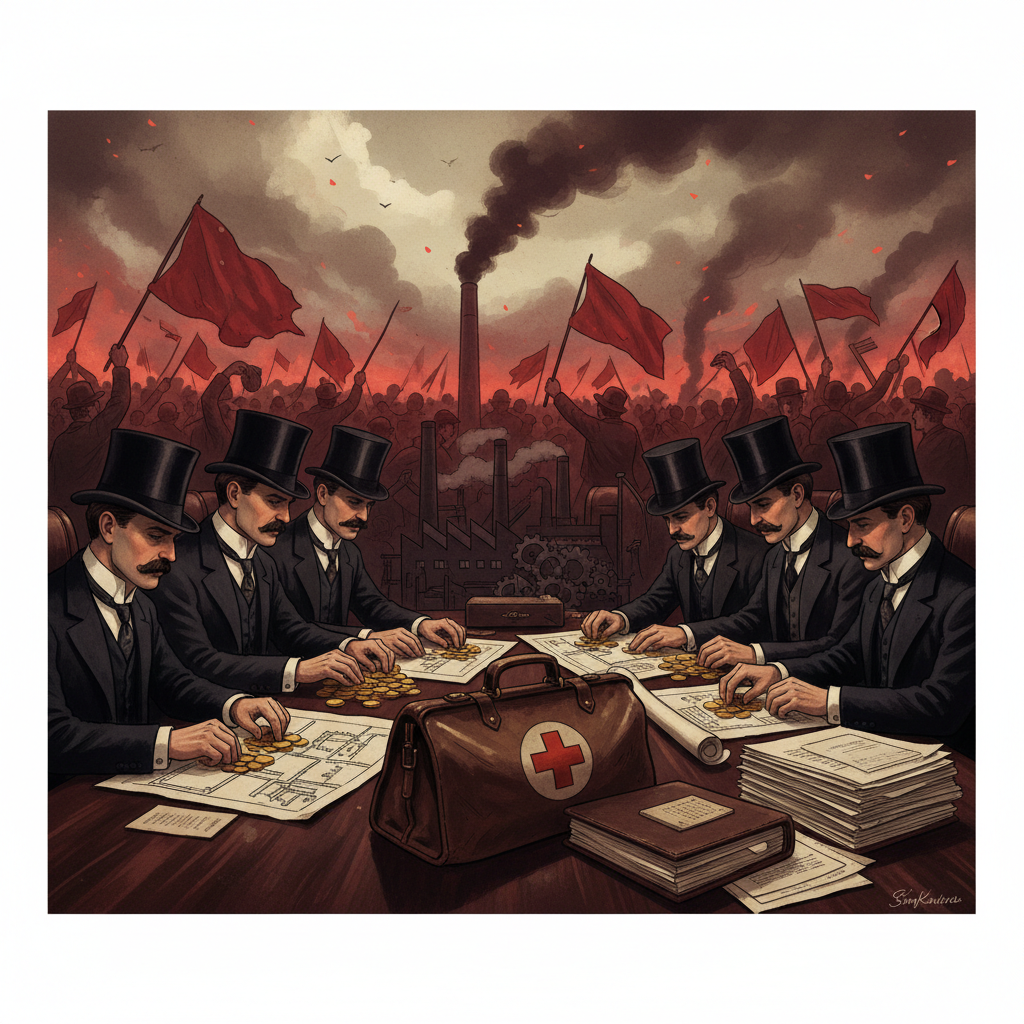
The anomaly begins with a peculiar humanitarian mission. In 1917, the American Red Cross dispatched a mission to Russia. On the surface, its purpose was to provide medical aid to the victims of war and revolution. Yet, a closer look at the passenger manifest reveals a shocking disproportion: the mission was comprised of more financiers, lawyers, and businessmen than it was of medical doctors. This discrepancy serves as the jumping-off point for a chilling exploration into how “International Finance” played a pivotal role in the birth of Soviet Russia.
The Red Cross Mission: A Trojan Horse for Finance
The 1917 Red Cross Mission to Russia was not funded by the American public or the Red Cross headquarters in Washington. Instead, it was financed largely by William Boyce Thompson, a director of the Federal Reserve Bank of New York. Thompson was a quintessential Wall Street titan, a man whose interests lay in copper, coal, and the soaring heights of the stock market. Why would such a man spend his personal fortune to send a “medical” team to Petrograd?
As Sutton details in Wall Street and the Bolshevik Revolution, the mission acted more like a diplomatic and commercial hit squad than a relief effort. While the nominal doctors were busy in wards, the financiers were in the halls of the Winter Palace, negotiating with the Provisional Kerensky government and, eventually, the Bolsheviks. Their goal was not just to help the sick; it was to secure a foothold in the massive, untapped Russian market. By positioning themselves as “humanitarians,” they gained access that private corporate agents never could have achieved during a time of total war.
The Curious Case of Leon Trotsky
One of the most persistent myths of the 20th century is that the Bolsheviks were an isolated group of revolutionaries. However, records show that key figures received unexpected help from Western centers of power. Specifically, the case of Leon Trotsky—the fiery Marxist revolutionary—raises significant questions. While living in New York, Trotsky was granted a passport to return to Russia to participate in the revolution.
When Trotsky’s ship was intercepted by Canadian authorities in Halifax, Nova Scotia, he was detained as a dangerous radical who intended to pull Russia out of the war against Germany. Yet, influential forces in Washington and London intervened to secure his release. Sutton’s investigation in Wall Street and the Bolshevik Revolution points to the involvement of Wall Street-linked officials who saw in the Bolsheviks a “demolition crew” capable of sweeping away the old order to make way for a more “manageable” state-controlled economy.
Monopoly Capitalism and State Socialism: Two Sides of the Same Coin?
To the casual observer, the idea of a capitalist funding a communist seems like a paradox. However, from the perspective of a monopolist, the two systems share a key trait: centralization of power. A free-market economy is chaotic and unpredictable; it allows for competition that threatens established wealth. A state-controlled economy, conversely, provides a single point of contact—a central authority with which large corporations can negotiate exclusive contracts.
Sutton argues that the elite financiers of the era were not afraid of socialism; rather, they viewed it as a tool for “captive market” expansion. By helping to establish a centralized Soviet government, these businessmen hoped to manage Russian resources under the guise of state-to-state cooperation. This “corporate socialism” is a central theme explored throughout Wall Street and the Bolshevik Revolution.
The Laundering of Bolshevik Gold
Following the 1917 coup, the Bolsheviks found themselves in possession of vast quantities of gold seized from the Tsarist treasury and the Russian Church. However, this “blood gold” could not be easily traded on international markets due to legal restrictions and the lack of diplomatic recognition. This is where Morgan banking executives entered the picture.
Sutton’s research into State Department files reveals that executives from the Guaranty Trust (a Morgan-controlled entity) and other Wall Street firms played an active role in funneling this illegal gold into the United States. This was not merely a matter of profit; it was about ensuring the survival of the Bolshevik regime during its most vulnerable years. Without access to international capital and the ability to convert gold into machinery and supplies, the revolution may have collapsed under the weight of its own economic incompetence.
American Corporations and the Soviet Market
It is often assumed that American business only began interacting with the USSR after official diplomatic recognition in 1933. Sutton proves this wrong. A decade and a half before FDR’s recognition, major corporations like General Electric, Rockefeller’s Standard Oil, and International Harvester were already making deals with the Soviets. These companies didn’t just sell products; they built the very infrastructure of the Soviet Union.
- The Dnieper River Dam: Largely built by American engineers and equipment.
- The Soviet Automotive Industry: Heavily indebted to the designs and factory layouts provided by Henry Ford.
- Oil Refining: Standard Oil of New York assisted in the modernization of Russian oil fields, ensuring the regime had the energy resources to industrialize.
In Wall Street and the Bolshevik Revolution, Sutton provides the paper trail for these transactions, showing how the “enemies of capitalism” were, in fact, the greatest customers of the world’s largest capitalists.
The Sutton Trilogy: A Larger Pattern of Control
Antony Sutton’s work on the Bolsheviks was not an isolated study. It was part of a broader, more disturbing trilogy that explored the influence of Western finance on the rise of totalitarian regimes. The other volumes, “Wall Street and the Rise of Hitler” and “Wall Street and FDR,” complete a picture of a financial elite that plays all sides of a conflict to ensure their own dominance.
The Methodology of a Courageous Scholar
What makes Sutton’s work so compelling is his reliance on primary sources. He was a research fellow at the Hoover Institution at Stanford University, and his books are not based on hearsay or “conspiracy theories” in the modern derogatory sense. Instead, he utilizes:
- Declassified State Department files.
- Personal papers of figures like Thomas Lamont and Edward House.
- Corporate board minutes and shipping manifests.
- Biographies written by contemporaries of the events.
Through these documents, he establishes tangible links that have been omitted from standard historical pedagogy.
Why Does This History Matter Today?
Understanding the foundations of Western funding of the Soviet Union is more than an academic exercise. it challenges our understanding of geopolitical shifts in the modern era. If international finance was willing to support a regime that murdered millions in the name of the “proletariat,” what does that say about the ethics of modern globalization? The lessons found in Wall Street and the Bolshevik Revolution provide a lens through which we can view current relationships between multinational corporations and authoritarian states.
The Myth of Choice
Sutton’s work suggests that the “clash of ideologies” is often a distraction from the underlying consolidation of power. When we see leading businessmen publicly championing free enterprise while privately sponsoring its most virulent enemies, we must ask ourselves who truly benefits from global conflict. The 1917 Red Cross mission was a masterclass in the use of “soft power” and humanitarian cover to achieve hard-nosed financial objectives.
Conclusion: Challenging the Narrative
The history of the 20th century is written by the victors, but the accountants and archivists occasionally leave behind a different story. Antony Sutton’s dispassionate and heavily documented study remains a crucial tool for anyone seeking to understand the hidden mechanics of history. By tracing the flow of money, Sutton reveals that the Bolshevik Revolution was not just a Russian event, but a global one—orchestrated, in part, from the boardrooms of New York and London.
For those interested in the full, unvarnished details of this era, the classic study remains as relevant today as it was when first published in 1974. To ignore the evidence of these historical links is to remain blind to the forces that continue to shape our world. The documented reality of the 1917 mission to Russia serves as a permanent reminder: always follow the money.
Discover more from Unread Page
Subscribe to get the latest posts sent to your email.