The Roswell Legacy: How Alien Tech Transformed the World

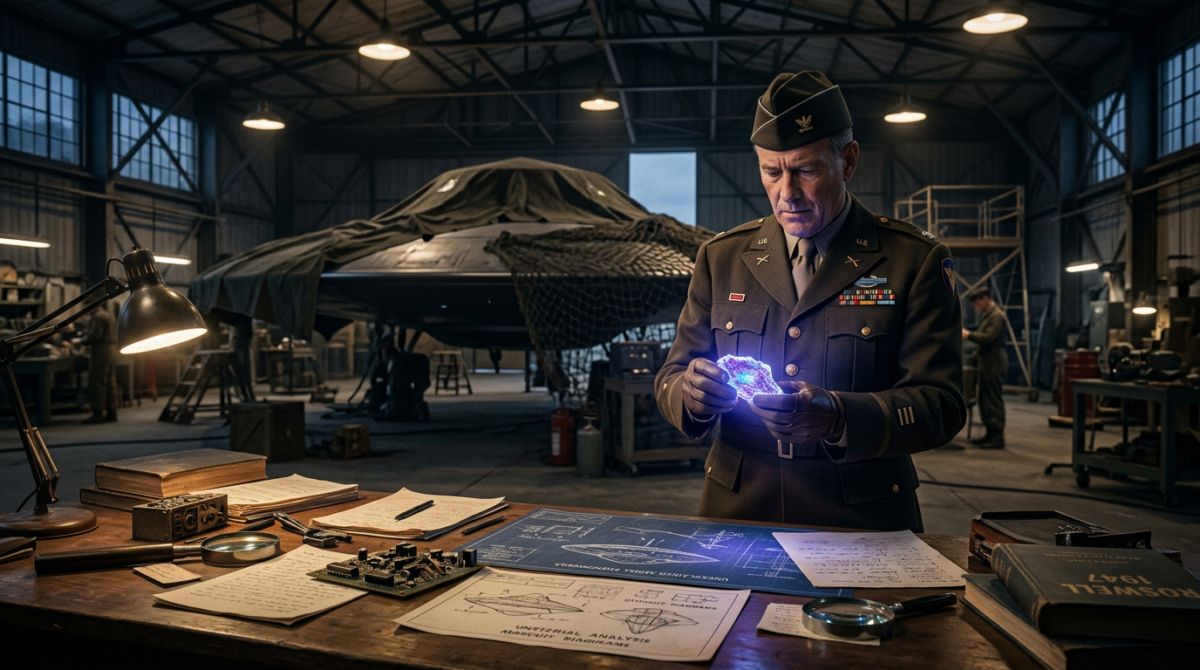
The Truth Behind the Roswell Incident: More Than Just a Myth
In July 1947, a mysterious event occurred in the high desert of Roswell, New Mexico, that would forever alter the trajectory of human history. For decades, the official narrative shifted from a “flying disc” to a weather balloon, leaving the public in a state of perpetual skepticism. However, the testimony of high-ranking military officials has since painted a far more complex picture. One of the most significant accounts comes from Colonel Philip J. Corso, whose revelations in his memoir, The Day After Roswell, suggest that the artifacts recovered from that crash site didn’t just prove we weren’t alone—they provided the blueprint for the modern world.
The story of Roswell is often dismissed as science fiction, but when viewed through the lens of military intelligence and technological leaps, the evidence becomes startling. Corso, a former member of President Eisenhower’s National Security Council, claimed his role was to “seed” alien technology into the American industrial complex. This process, known as reverse engineering, is at the heart of the modern technological revolution.
Who Was Colonel Philip J. Corso?
Before diving into the mechanics of the crash, it is essential to understand the credibility of the man behind the exposé. Colonel Philip J. Corso was not a conspiracy theorist; he was a decorated officer with a distinguished career in the United States Army. Serving on the Foreign Technology Desk, he had access to some of the nation’s most closely guarded secrets.
In his groundbreaking book, The Day After Roswell, Corso details his assignment to oversee the distribution of fragments recovered from the 1947 crash. His mission was simple yet profound: find a way to integrate this “foreign” technology into American research and development without revealing its extraterrestrial origins. This clandestine operation was handled under the guise of capturing Soviet or other adversarial tech breakthroughs.
From Roswell to Your Pocket: The Hidden Tech Revolution
The most compelling aspect of the Roswell legacy isn’t just the existence of Unidentified Aerial Phenomena (UAP), but the specific technologies that emerged shortly after the event. Corso argued that many of the silicon-based advancements we take for granted today were born from the debris of the Roswell craft.
1. The Birth of the Integrated Circuit
Before 1947, electronics relied on bulky, fragile vacuum tubes. After the Roswell incident, the world suddenly saw the emergence of the transistor and, subsequently, the integrated circuit. Corso describes in The Day After Roswell how the microscopic “wafers” found in the craft led to the miniaturization of electronics. Today, the smartphone in your pocket is a direct descendant of those early experiments in reverse engineering.
2. Fiber Optics and High-Speed Communication
The wreckage reportedly contained strange, hairlike glass fibers that could transmit data with incredible efficiency. While mainstream science attributes fiber optics to gradual human innovation, Corso suggests that the “seeds” for this technology were gifted by the Roswell crash. This breakthrough allowed for the rapid expansion of global telecommunications and the eventual birth of the internet.
3. Kevlar and Advanced Materials
One of the most famous descriptions of the Roswell debris involved a “memory metal” or foil-like substance that could be crumpled into a ball and would instantly return to its original shape. This led to research into high-tensile materials and ballistic-resistant fabrics. The development of Kevlar and other super-alloys mirrors the descriptions provided by Corso in The Day After Roswell.
The National Security Implications
Why was this kept a secret for so long? During the height of the Cold War, the United States was in a desperate arms race with the Soviet Union. If the military truly possessed technology that bypassed centuries of human development, revealing it would have been a catastrophic security risk. Colonel Corso explains that the “Foreign Technology” cover was the only way to protect the discovery while ensuring the U.S. maintained a military advantage.
- Strategic Advantage: Maintaining the element of surprise in aerospace technology.
- Social Stability: Avoiding the mass panic that might follow an official confirmation of extraterrestrial life.
- Economic Control: Managing the slow release of technology to protect existing industries.
The Eisenhower Connection
As a member of President Eisenhower’s National Security Council, Corso was uniquely positioned to see how the highest levels of government managed the “alien problem.” Eisenhower is often rumored to have had meetings regarding the UAP phenomenon, and Corso’s accounts lend significant weight to these theories. In The Day After Roswell, the author chronicles the delicate balance of power and the “Cold War within a Cold War” that took place behind closed doors.
Is the Roswell Narrative Still Relevant Today?
With the recent surge in UAP disclosures from the Pentagon and testimony before Congress by whistleblowers like David Grusch, the Roswell incident has moved from the fringes of history back into the spotlight. The core question remains: Is our government still in possession of “non-human intelligence” artifacts?
The echoes of Corso’s claims are heard in modern legislative efforts to grant amnesty to defense contractors who come forward with “legacy programs” involving recovered craft. If Corso was telling the truth, then the rapid technological acceleration of the 20th century wasn’t just human ingenuity—it was a guided evolution.
The Moral Dilemma of Reverse Engineering
If we have been using “borrowed” technology for 75 years, it raises significant ethical questions. Have we suppressed clean energy technologies to maintain the oil-based economy? Has the military-industrial complex grown too powerful because of its monopoly on these secrets? These are the questions that keep readers returning to the pages of The Day After Roswell.
Conclusion: Deciphering the Legacy
The Roswell crash was more than just a momentary headline in a 1947 newspaper. It was a catalyst that propelled humanity into the silicon age. While skeptics will always exist, the testimony of Colonel Philip J. Corso provides a logical, albeit shocking, explanation for how we went from vacuum tubes to supercomputers in a single generation.
Whether you are a believer in extraterrestrial life or a military history enthusiast, the Roswell story demands attention. It is a thriller that is still being written, and its ending will likely determine the future of our species among the stars.
Key Takeaways from Corso’s Revelations:
- Roswell wasn’t a weather balloon; it was a craft of unknown origin.
- The U.S. Army used private industry to hide and develop recovered technology.
- Modern innovations like lasers, night vision, and chips have roots in the 1947 crash.
- The secrecy was driven by Cold War necessity but persists for economic reasons.
Discover more from Unread Page
Subscribe to get the latest posts sent to your email.