The Mystery of Human Prehistory: Graham Hancock’s Lost Civilization

The Great Mystery of Human Prehistory
For decades, the standard narrative of human history has been relatively straightforward: we transitioned from hunter-gatherers to settled farmers around 10,000 years ago, eventually building the first great civilizations in Mesopotamia and Egypt. But what if this timeline is fundamentally incomplete? What if a high civilization, possessing advanced scientific knowledge, flourished during the Ice Age and was wiped out by a global cataclysm? This is the provocative thesis explored in the seminal work Fingerprints of the Gods: The Evidence of Earth’s Lost Civilization.
Graham Hancock, now a household name thanks to his hit Netflix original docuseries Ancient Apocalypse, has spent his career challenging the archaeological status quo. His research suggests that the story of mankind is far older than we have previously believed. By utilizing tools as varied as archaeo-astronomy, geology, and computer analysis of ancient myths, Hancock presents a compelling case that demands our attention.
The Fingerprints Left Behind: From the Andes to Egypt
The core of the argument presented in Fingerprints of the Gods: The Evidence of Earth’s Lost Civilization lies in the physical evidence scattered across the globe—monuments that seem to defy the technological capabilities of the peoples traditionally credited with their construction. Hancock embarks on a worldwide quest to put together the pieces of a vast and fascinating jigsaw puzzle of mankind’s hidden past.
The Enigma of Tiahuanaco
High in the Bolivian Andes lies Tiahuanaco, a site of staggering megalithic precision. The stones here are vast, some weighing over 100 tons, yet they were moved and fitted with such accuracy that it suggests a level of engineering sophistication unmatched in the ancient world. Hancock explores the astronomical alignments of these ruins, arguing that they point to a construction date significantly older than the 1,500 years recognized by mainstream archaeology.
The Great Sphinx and Geological Dating
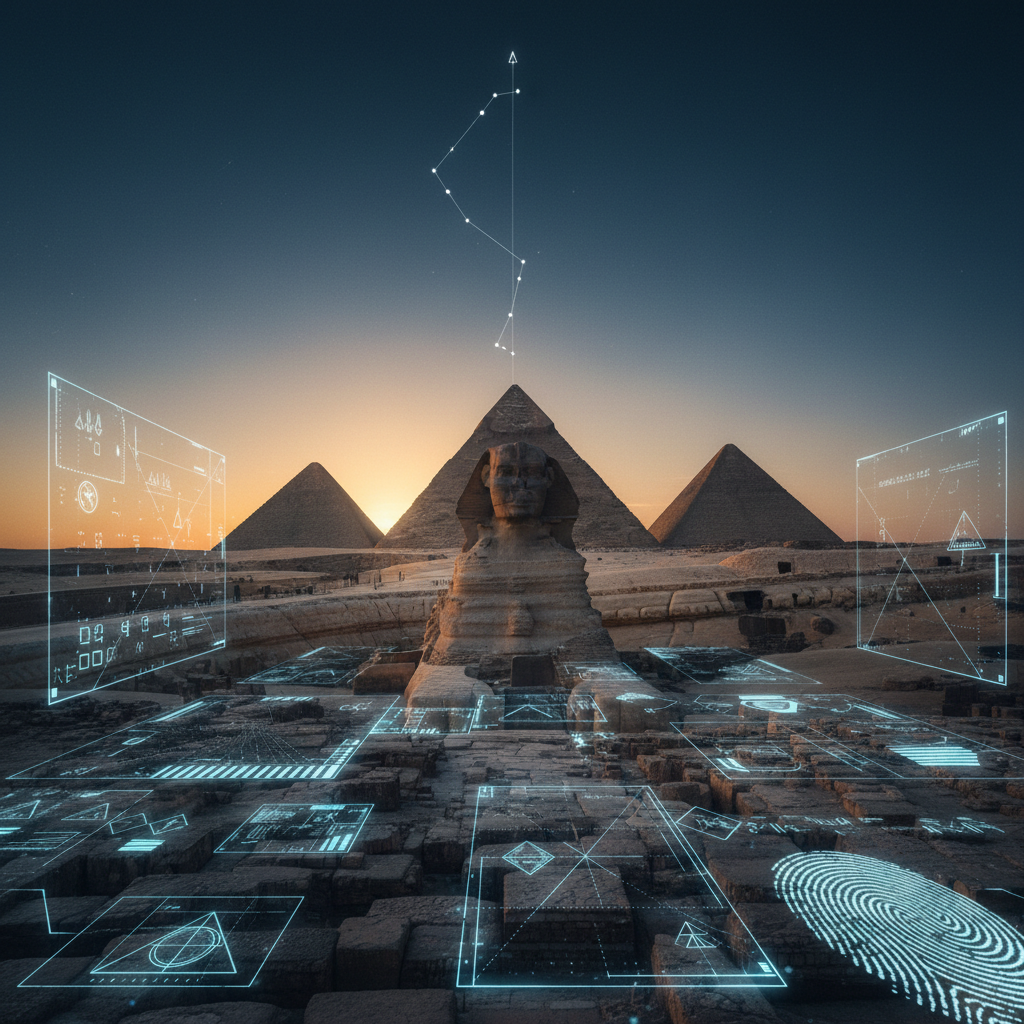
In Egypt, the Great Sphinx stands as a silent sentinel of a forgotten era. While traditional Egyptology dates the Sphinx to the reign of Khafre (around 2500 BC), Hancock highlights the work of geologists who point to vertical weathering patterns on the monument and its enclosure. These patterns, caused by heavy, prolonged rainfall, suggest that the Sphinx was carved at the end of the last Ice Age—a time when the Giza plateau experienced a much wetter climate than the desert we see today.
This geological evidence, combined with the astronomical positioning of the Pyramids mirroring the constellation of Orion in 10,500 BC, forms a cornerstone of the research found in Fingerprints of the Gods: The Evidence of Earth’s Lost Civilization. It suggests that a master plan was in place thousands of years before the rise of the Dynastic Egyptians.
Archaeo-Astronomy: Reading the Stars
One of the most fascinating aspects of Hancock’s work is his use of archaeo-astronomy. Ancient monuments were not just physical structures; they were sophisticated “calculators” built to track the stars and the precession of the equinoxes. This slow wobbling of the Earth’s axis takes approximately 25,920 years to complete one full cycle, changing the backdrop of the stars behind the sun at the spring equinox.
To record and understand this phenomenon requires advanced mathematical knowledge and observation over centuries. Yet, we find this specific numbering embedded in myths and temple architectures from Mexico to Cambodia. In Fingerprints of the Gods: The Evidence of Earth’s Lost Civilization, Hancock reveals the startling evidence of an evolved scientific knowledge shared by these distant cultures, suggesting a common, much older source of wisdom.
Ancient Myths as Scientific Records
Beyond stone and mortar, Hancock looks at the “software” of ancient history: myths and legends. By using computer analysis of myths from around the world, certain recurring themes emerge. From the Epic of Gilgamesh to the legends of the Maya and the Hopi, stories of a great global flood and the “civilizing heroes” who arrived in its aftermath are ubiquitous.
Instead of dismissing these as mere fantasy, Hancock views them as a record of historical memory—a way for survivors of a lost age to transmit vital information to future generations. These stories often contain precise mathematical information and warnings about the cyclical nature of Earth’s stability.
The Warning: A Cycle of Cataclysm
Perhaps the most chilling aspect of the research is the “warning” handed down through the ages. As we recover the truth about prehistory, it becomes apparent that our ancestors were obsessed with time and the stars because they knew the Earth was subject to periodic, violent changes. As noted in Fingerprints of the Gods: The Evidence of Earth’s Lost Civilization, these cataclysms afflict the Earth in great cycles at irregular intervals—and we may be due for another such event.
The Younger Dryas Impact Hypothesis
Recent scientific developments have begun to catch up with the theories proposed decades ago by Hancock. The Younger Dryas Impact Hypothesis suggests that around 12,800 years ago, fragments of a disintegrating comet struck the Earth, causing massive wildfires, global flooding, and a sudden plunge back into Ice Age conditions. This event perfectly aligns with the timeline Hancock proposes for the destruction of the “Lost Civilization.”
An Intellectual Revolution
Kirkus Reviews described the book as “a fancy piece of historical sleuthing . . . intriguing and entertaining and sturdy enough to give a long pause for thought.” Indeed, the impact of these theories has been profound. A record-breaking number one bestseller in Britain upon its release, the book fueled an intellectual revolution that continues to this day, as seen in the popularity of the Netflix series Ancient Apocalypse.
By questioning the linear progression of human history, we open the door to a more complex and fascinating understanding of who we are. We are not just the product of a slow climb from the caves; we may be a “species with amnesia,” struggling to remember a golden age that was lost to the stars and the seas.
Conclusion: Why This Matters Today
Why should we care about a lost civilization from 12,000 years ago? Because understanding our past is key to navigating our future. If our ancestors left us a “message in a bottle” through their monuments and myths, it is our responsibility to decode it. The sophisticated technology and advanced knowledge of this remote antiquity suggest that we are capable of much more than we realize—and that we are more vulnerable to terrestrial cycles than we care to admit.
Whether you are a skeptic or a believer, the journey through human history’s hidden corridors is an essential one. To start your own exploration into these prehistoric mysteries, you can delve into the detailed research of Graham Hancock by reading Fingerprints of the Gods: The Evidence of Earth’s Lost Civilization. Change the way you understand your past, and you will inevitably change the way you see the future.
Discover more from Unread Page
Subscribe to get the latest posts sent to your email.