Hollow Earth Theory: The Secrets of Agartha and Subterranean Worlds

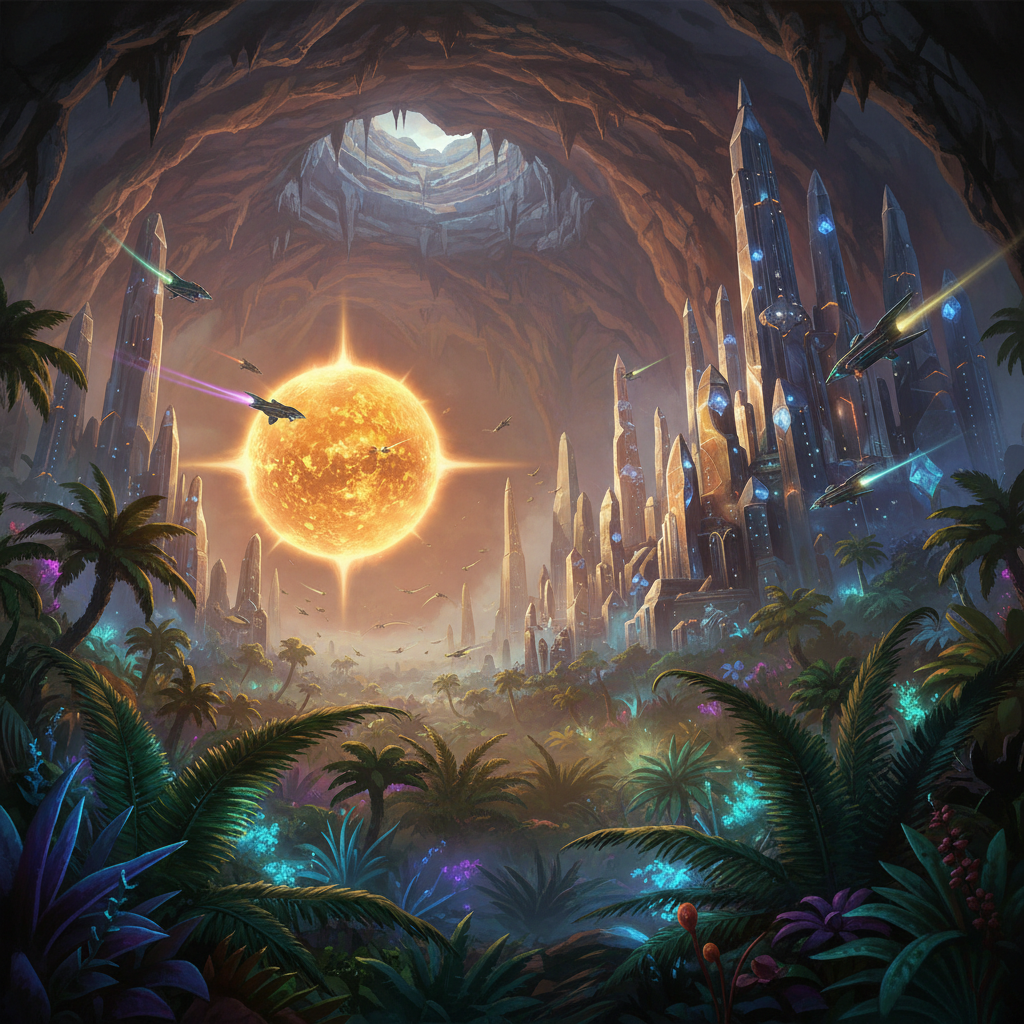
The Enigma of the Hollow Earth: Beyond Myth and Legend
For centuries, the concept of a Hollow Earth or a “Honeycombed Earth” has occupied the periphery of scientific discourse and the center of esoteric tradition. While modern geology describes the Earth as a series of solid and molten layers—crust, mantle, and core—ancient myths and persistent modern accounts suggest a far more mysterious reality. The thesis that our planet harbors vast, habitable subterranean worlds is a recurring theme in human history, suggesting that the ground beneath our feet may not be as solid as we have been led to believe.
From the high plateaus of Tibet to the frozen reaches of the Arctic, legends of Agartha and Shambhala persist. These are not merely stories of caves, but of advanced civilizations residing in “cavern-cities.” To understand the weight of these claims, one must look at the work of researchers like Robert Sepehr, whose book Gods with Amnesia: Subterranean Worlds of Inner Earth explores the anthropological and occult evidence for these hidden realms. If these legends hold even a grain of truth, we must confront profound questions about biology, physics, and the hidden history of the human race.
Ancient Traditions: The Map to Agartha and Shambhala
The names Agartha and Shambhala resonate through the corridors of Eastern mysticism. In Hindu and Buddhist traditions, these are not metaphors for a state of mind, but physical locations accessible through secret gateways. Shambhala, often translated from Sanskrit as the “place of tranquility,” is described as a kingdom where spiritually advanced beings reside, acting as the silent watchers of humanity’s evolution.
- Tibet: Local folklore insists on a network of tunnels connecting the Potala Palace in Lhasa to a vast underground network.
- India: Ancient texts speak of the Patala, a subterranean region inhabited by the Nagas, a highly intelligent race of serpent-like beings.
- Native American Traditions: The Hopi people speak of the “Ant People” who led them into underground caves to survive global cataclysms.
- South America: Stories of the Cueva de los Tayos in Ecuador suggest a massive library of metal plaques hidden deep within the earth.
These myths share a common thread: the subterranean world is a refuge. It is a sanctuary for antiluvian civilizations—those who existed before the Great Flood—who sought safety from surface catastrophes. In Gods with Amnesia: Subterranean Worlds of Inner Earth, Sepehr posits that these “gods” are actually our forgotten ancestors, possessing technology and knowledge that far exceeds our current understanding.
The Physics of Survival: How Life Thrives Without the Sun
The most common skepticism regarding a hollow or honeycombed earth concerns the biological requirements for life. How could a complex biosphere exist without the sun? To address this, we must look at both theoretical physics and discovered extremophiles.
1. The Problem of Light and Photosynthesis
Mainstream biology dictates that life requires sunlight for photosynthesis. However, proponents of the Inner Earth theory suggest the existence of a “Central Sun” or a highly energized plasma core that provides perpetual light and warmth. If this sounds like science fiction, consider the discovery of chemochemical synthesis. Deep-sea hydrothermal vents support thriving ecosystems in total darkness, utilizing chemical energy rather than solar energy. In a large-scale subterranean environment, a similar process involving atmospheric ionization or bioluminescent flora could provide the necessary energy for a food chain.
2. Atmospheric Ventilation
How would inhabitants breathe miles below the surface? Skeptics point to the crushing pressure and lack of oxygen. However, the “Honeycombed Earth” theory suggests that the planet is porous. Vast convection currents could circulate air through massive polar openings and smaller cave systems. Furthermore, advanced civilizations would likely employ electromagnetic air purification and oxygen-generating botanical gardens, creating a self-sustaining “closed-loop” atmosphere.
3. Sustenance and Water
Water is perhaps the easiest resource to account for. Geologists have recently discovered “oceans” of water trapped within the Earth’s transition zone, stored inside a mineral called ringwoodite. This suggests the interior could hold three times as much water as the surface oceans. For food, the legends describe giant flora and “manna-like” substances, potentially high-protein fungi or genetically engineered crops that require minimal light.
Operation Highjump and the Polar Enigma
The search for the Inner Earth is not limited to ancient scrolls. In the mid-20th century, military interest in the poles reached a fever pitch. Operation Highjump (1946-1947), led by Rear Admiral Richard E. Byrd, was officially a scientific expedition to Antarctica. However, the scale of the operation—involving 4,700 men, 13 ships, and multiple aircraft—suggests a mission of a different nature.
Rumors persist that Byrd’s team encountered “flying discs” and an entrance to a world beyond the poles. While mainstream history records the expedition as a success, many classified files remain hidden. Byrd himself famously remarked in an interview that it was “imperative for the United States to initiate immediate defense measures against hostile regions,” referring to the polar areas. This historical anomaly is a cornerstone of the research presented in Gods with Amnesia: Subterranean Worlds of Inner Earth, which examines the possibility that the Nazis or other groups established contact with subterranean races during the war years.
Who Dwells Within? The Races of the Inner World
If the Inner Earth is inhabited, who are its residents? According to various esoteric sources and “contactee” reports, there are several distinct groups:
- The Elders: The remnants of the Hyperborean or Lemurian civilizations, described as tall, fair-skinned, and highly telepathic.
- The Vril-Ya: A race popularized by Edward Bulwer-Lytton, said to command a fundamental energy force known as “Vril” that can heal or destroy.
- The Reptilians/Nagas: Ancient entities that feature heavily in Indian and South American mythology, often described as living in the deepest layers of the crust.
Anthropologist Robert Sepehr suggests that the “Gods” of our mythologies were not extraterrestrial, but intraterrestrial. They were the survivors of the Younger Dryas cataclysm, a period of sudden cooling and flooding roughly 12,800 years ago. While surface humanity fell into a “dark age” of amnesia, those who fled underground preserved their genetic lineage and technological prowess.
Scientific Anomalies Supporting a Porous Earth
Modern seismic data is often cited as proof that the Earth is solid. However, seismic waves behave strangely when passing through certain depths. Scientists have noted “zones of silence” and anomalies where waves travel faster than expected, hinting at large subterranean voids or liquid-filled chambers. Furthermore, the Earth’s magnetic field is generated by the movement of the core—if that core is a plasma-based “inner sun” rather than a solid ball of iron, many of our magnetic mysteries could be solved.
Moreover, the existence of deep-earth microorganisms found in mines three miles deep suggests that life is far more resilient than we once thought. If microbes can survive in the heat and pressure of the deep crust, why couldn’t a more complex organism—aided by technology—do the same in larger, pressurized caverns?
Conclusion: The Awakening to our Inner World
The idea of a Hollow Earth challenges the very foundation of modern geography and history. Yet, when we bridge the gap between ancient mythology and modern “classified” military history, a different picture emerges. We live on the surface of a planet that may be teeming with life and history beneath us, a “place of tranquility” hidden from the chaos of the surface world.
As we continue to explore the deepest oceans and the furthest reaches of space, perhaps the greatest discovery awaits us right beneath our feet. The research of Robert Sepehr serves as a vital catalyst for this inquiry. For those willing to look beyond the veil of mainstream academia, the secrets of Agartha and the true origin of the human race are waiting to be rediscovered.
Discover more from Unread Page
Subscribe to get the latest posts sent to your email.