Exopolitics: Extraterrestrial Presence and Secret Space Programs

The Birth of a New Paradigm: Understanding Exopolitics
In the early 2000s, the conversation surrounding Unidentified Flying Objects (UFOs) was largely confined to grainy photographs and eyewitness accounts of lights in the sky. However, a seismic shift occurred in 2004 with the release of a groundbreaking text that moved the conversation from ‘do they exist?’ to ‘how do we interact with them?’ This seminal work, Exopolitics: Political Implications of the Extraterrestrial Presence, became the first published book to formalize the field of exopolitics—the study of the actors, institutions, and processes associated with extraterrestrial life.
Exopolitics treats the presence of non-human intelligence not as a scientific curiosity, but as a geopolitical reality with profound implications for global governance, social structures, and planetary security. By analyzing the political dimensions of the extraterrestrial presence, researchers began to uncover a hidden layer of international relations that had previously been relegated to the realm of science fiction.
Categorizing the Visitors: Typologies and Motivations
One of the most significant contributions of the 2004 publication was the introduction of a comprehensive typology of extraterrestrial civilizations. Rather than viewing ‘aliens’ as a monolithic entity, the book categorized various visitors based on their biological characteristics, technological capabilities, and, most importantly, their motivations for interacting with Earth.
The Strategy of Categorization
By using diverse sources of information—ranging from remote viewing data and contactee reports to leaked government documents—the field of exopolitics began to map out a complex ‘galactic neighborhood.’ These groups were often divided into three primary categories:
- Service-to-Self Groups: Entities primarily interested in resource extraction, genetic experimentation, or strategic influence over human institutions.
- Service-to-Others Groups: Civilizations focused on spiritual evolution, ecological preservation, and providing assistance to humanity without violating the principle of non-interference.
- Neutral or Observational Groups: Scientific missions or nomadic cultures that monitor Earth’s development as a case study in planetary evolution.
Understanding these motivations is crucial for any diplomatic framework. As outlined in Exopolitics: Political Implications of the Extraterrestrial Presence, the failure of mainstream political science to account for these external actors has left humanity vulnerable to manipulation by groups with clandestine agendas.
The Emergence of Secret Space Programs and Supersoldiers
Perhaps the most controversial and ahead-of-its-time aspect of early exopolitical research was the inclusion of whistleblower testimonies. These accounts detailed the existence of secret military space forces, which many researchers now refer to as the Secret Space Program (SSP). Long before the public announcement of the U.S. Space Force, exopoliticians were documenting claims of off-planet military operations.
Whistleblowers and the ‘Supersoldier’ Phenomenon
The 2004 text was among the first to bring the narrative of ‘supersoldiers’ into the public consciousness. These individuals claimed to have been recruited into highly classified programs involving genetic enhancement, psychological conditioning, and service in clandestine conflicts. According to these testimonies, humanity had already established a presence on the moon, Mars, and beyond, facilitated by a technological ‘breakaway civilization’ that operates independently of public oversight.
These programs were said to be funded by ‘black budgets’—trillions of dollars diverted from the mainstream economy into technological development far beyond the reach of the public eye. This hidden infrastructure represents a profound challenge to democratic accountability and global transparency.
Stargates and Ancient Technology: The True Drivers of Geopolitics
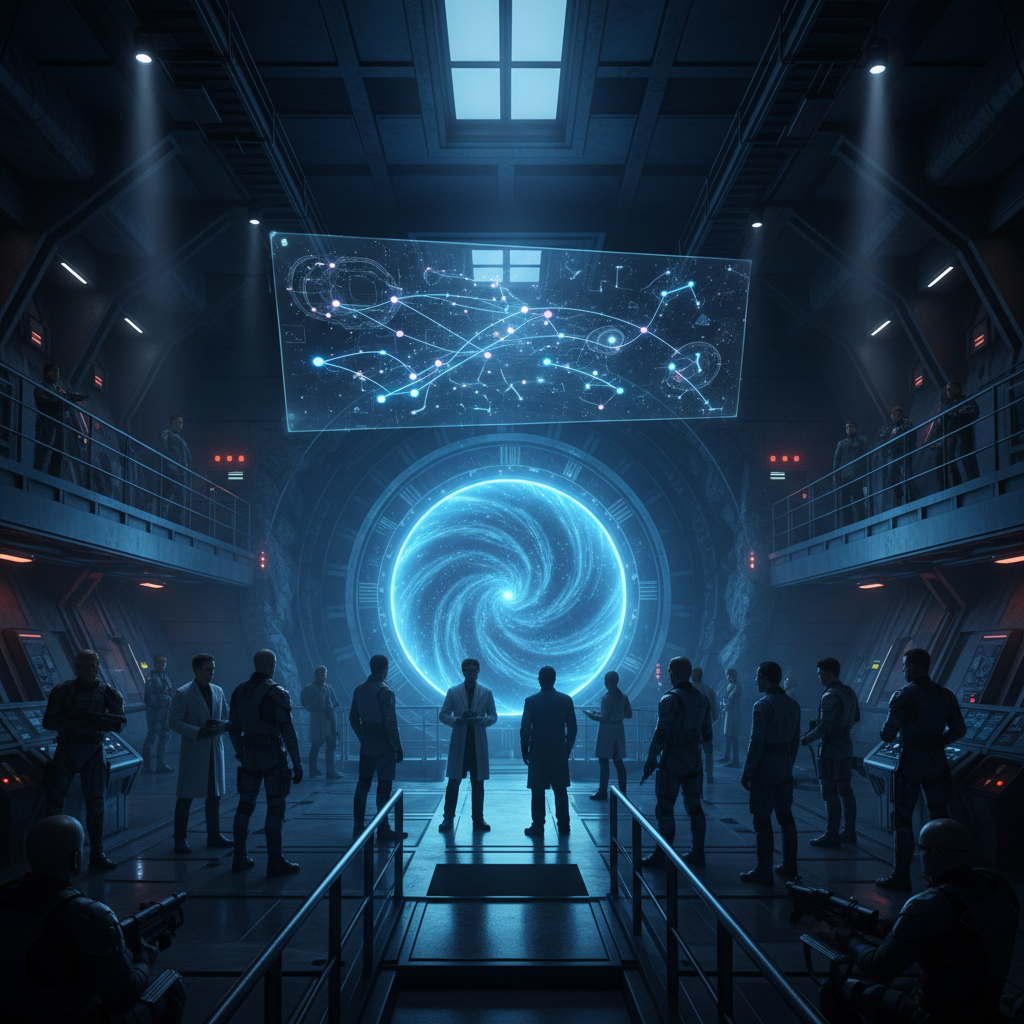
Beyond spacecraft and genetic engineering, the initial study of exopolitics introduced the concept of ‘space-time portals’ or stargates. These are not merely the stuff of Hollywood movies; according to exopolitical research, they are ancient technologies left behind by previous civilizations or gifted by extraterrestrial visitors.
The Quest for the Ancient ‘Stargates’
The struggle to control these portals has allegedly been a driving force behind modern geopolitical conflicts. The thesis presented in early exopolitics suggests that certain regions of the world—such as Iraq, Afghanistan, and parts of Africa—are not just strategic for their oil or mineral wealth, but for the ancient alien artifacts and transportation hubs buried beneath their soil.
Consider the following implications of stargate technology:
- Instantaneous Travel: The ability to move troops, resources, and information across solar systems in seconds.
- Infinite Energy: Powering the world without the need for fossil fuels, which would collapse the current petrodollar system.
- Temporal Manipulation: The potential to influence historical timelines, creating a ‘time war’ between competing factions.
The Geopolitical Conflict: Hidden Agendas Behind Modern Wars
When we look at the world through the lens of Exopolitics: Political Implications of the Extraterrestrial Presence, the headlines of major newspapers take on a different meaning. Geopolitics is no longer just about borders and trade; it is about which nation or ‘deep state’ faction gains access to the technological ‘holy grails’ that ensure planetary dominance.
The book posits that the high-level secrecy surrounding these technologies is maintained to prevent a global paradigm shift. If the public were to realize that the means for free energy and interplanetary travel already exist, the current structures of economic and social control would evaporate overnight. Therefore, the ‘UFO cover-up’ is fundamentally a political and economic strategy rather than a scientific one.
The Future of Exopolitics: From Secrecy to Disclosure
Today, the field of exopolitics is more relevant than ever. With the U.S. government moving toward limited disclosure through Congressional hearings and the declassification of UAP (Unidentified Anomalous Phenomena) files, the groundwork laid in 2004 provides a vital roadmap for understanding the current landscape.
Why This History Matters
We are currently witnessing a ‘disclosure battle’ between those who want to maintain the status quo of secrecy and those who believe humanity is ready to join the galactic community. By studying the origins of this field, we can better decode the motivations of the actors involved in today’s news cycles. We are moving toward a ‘post-disclosure’ world where the political implications of an extraterrestrial presence will be the defining issue of the 21st century.
Conclusion: Embracing the Galactic Perspective
The journey into exopolitics is a journey into the heart of the human experience. It challenges us to rethink our place in the universe and to demand transparency from the institutions that govern us. As we look back at the pioneering work that started it all, we recognize that the questions raised decades ago have now become the most pressing issues of our time.
The era of isolation is ending. Whether through secret space programs, ancient stargates, or direct contact, the reality of our extraterrestrial neighbors is becoming impossible to ignore. It is time for a mature, informed, and public dialogue about our future as a spacefaring, galactic civilization.
Discover more from Unread Page
Subscribe to get the latest posts sent to your email.